A CRM Is Not a Sales System
Buying a CRM feels productive.
It feels like the business is getting serious.
There is a dashboard now. There are pipeline stages. There are contacts, tasks, reminders, automations, reports and probably a very confident sales rep from the software company who promised it would "transform the way your team sells."
And to be fair, a good CRM can be incredibly useful.
But here is the part a lot of businesses find out the hard way:
A CRM does not fix sales.
It only shows you what is happening, if the people using it know what they are doing.
Without a proper sales process behind it, a CRM is just an expensive place to store confusion.
It becomes a digital filing cabinet. A graveyard of half-updated opportunities. A place where old leads go to quietly disappear. Everyone technically has access, but nobody really trusts what is in there.
The founder still asks, "What's happening with that lead?"
The salesperson still says, "Yeah, I was going to follow that one up."
The pipeline still looks full, but somehow nothing moves.
That is not a software problem. That is a sales system problem.
Software does not create discipline
A CRM is only as useful as the behaviour around it. If the team is unclear on what needs to happen after a lead comes in, the CRM will not magically create clarity. If no one owns the next step, the CRM will not assign accountability by itself. If follow-up is slow, inconsistent or vague, the CRM will simply record the mess more neatly.
This is why so many businesses feel frustrated after setting up HubSpot, Pipedrive, Zoho, Salesforce or whatever platform they were told would change everything.
They expected the software to create discipline. But discipline has to be built into the way the business sells.
What a CRM should actually answer
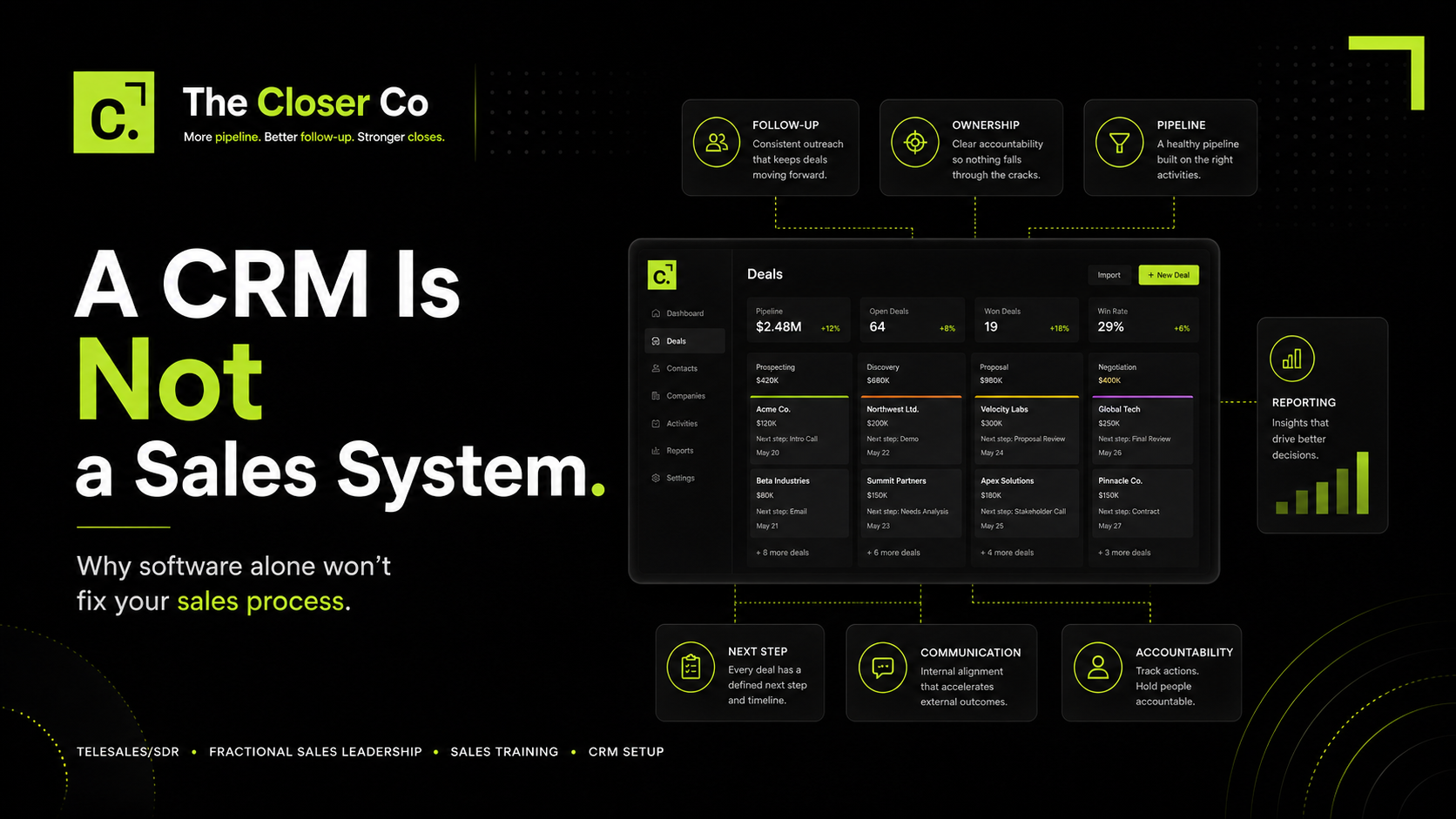
A CRM should answer simple questions. Who is this lead? Where did they come from? Who owns them? What stage are they at? What is the next step? When is the next follow-up? What has been said already? What is the deal worth? What is likely to close? What is stuck?
If your CRM cannot answer those questions quickly, it is not really operating as a sales system. It is just another tab open on someone's laptop.
The problem usually starts before the CRM
Most businesses do not have a clearly defined sales process before they choose the software. So they end up building their uncertainty into the system.
They create pipeline stages that sound good but do not mean much. They add fields nobody fills in. They set up automations nobody understands. They track activity without knowing what good activity looks like.
Then a few weeks later, the team starts avoiding it. Not because they are lazy. Because the CRM does not reflect how sales actually happens in the business.
So the work moves back to the usual places. Inbox. Phone notes. Spreadsheets. Memory. Random Slack messages. A notebook on someone's desk. The founder's brain.
And now the business has two problems. The sales process is still messy, and the CRM is now messy too.
Start with the sales reality, not the software features
A good CRM setup starts with the sales reality, not the software features.
Before worrying about dashboards and automations, the business needs to be clear on the basics.
What happens when a new lead comes in? Who responds? How fast? What makes a lead worth pursuing? What does a good first conversation need to uncover? When does an opportunity move from one stage to the next? What follow-up should happen after a call? When does a proposal get sent? Who chases it? When is a deal considered lost? What should be reviewed every week?
Those questions are not glamorous. They will not make anyone feel like they have discovered a revolutionary sales hack. But they are the difference between a CRM that gets used and a CRM that gets ignored.
The businesses that get value have the clearest rules
The businesses that get value from their CRM are not always the ones with the fanciest setup. They are the ones with the clearest rules.
Everyone knows what goes in. Everyone knows what needs to be updated. Everyone knows what the stages mean. Everyone knows what happens next.
That is when the CRM becomes useful. Not because the software is magic, but because the team now has a shared way to manage sales.
The founder no longer has to keep chasing for updates. The sales team cannot hide behind vague activity. The pipeline stops being a guessing game. Follow-up becomes visible. Stuck deals become obvious. Opportunities have owners. Sales meetings become sharper because everyone is looking at the same version of the truth.
That is the point of a CRM. Not to make the business look more organised. To make sales visible enough to manage.
Invisible sales problems are expensive
Because invisible sales problems are expensive.
A lead that has not been followed up looks harmless until you realise it was a real opportunity. A deal sitting in the wrong stage looks fine until the forecast is wrong. A salesperson saying "I'm all over it" sounds okay until there is no next step, no note and no movement.
A CRM should stop that from happening. But only if the process behind it is strong enough.
The CRM is where the system lives — it is not the system
The mistake is thinking the CRM is the system. It is not. The CRM is where the system lives.
The system is the way your business handles leads, moves opportunities, follows up, manages activity, reviews performance and creates accountability. That is the part most businesses are missing.
They do not need more fields. They need clearer ownership.
They do not need more dashboards. They need better pipeline discipline.
They do not need more automations. They need a follow-up rhythm that actually gets used.
They do not need a more complicated CRM. They need a simpler sales process that everyone can follow.
From software to system
The best CRM in the world will not save a business that does not know what should happen next. But a simple CRM, used properly, with a clear process behind it? That can change everything.
It can turn scattered sales activity into something visible. It can give the founder confidence that leads are being worked. It can help a sales team understand what matters. It can show where deals are getting stuck. It can make follow-up less random. It can turn sales from a collection of conversations into a function the business can actually manage.
That is the shift. From software to system. From contacts to pipeline. From notes to next steps. From vague activity to visible movement.
A CRM is not a sales system by itself. But when it is built around a real sales process, it becomes one of the most valuable tools in the business.
Not because it closes deals. Because it helps make sure the right things happen before the deal is won.
/ Stop letting deals stall